
“A child’s world is fresh and new and beautiful, full of wonder and excitement.” - Rachel Carson


A wise buddy HomePod, for every growing mind.
CoRover.ai | BharatGPT | Edgehax · 2026
Solo project · 2 months · Handcrafted by Artisan in Channapatna
Kanha is a voice-first, screen-free AI companion for children, handcrafted in Channapatna wood, shaped by the Krishna archetype, and governed entirely by parents. Built with CoRover.ai and BharatGPT, it answers a gap no product had filled: intelligence that arrives calmly, culturally familiar, and without a screen.


A wise buddy HomePod, for every growing mind.
Solo project · 2 months
CoRover.ai | BharatGPT | Edgehax · 2026
A voice-first, screen-free AI companion for children, handcrafted in Channapatna wood, governed by parents.


Product design, AI interaction, service ecosystem, brand direction.

A companion built on the Krishna archetype: a friend, not an authority.

A full product proposition, priced at ₹7,999.

Smart toys are interactive but cold. Traditional toys are warm but static.
CoRover.ai is an Indian conversational AI company building human-centric, responsible AI systems - natural, multilingual interaction through conversational and agentic platforms that prioritise trust, accessibility, and real-world relevance. Its sovereign language model, BharatGPT, is built to align with local languages, cultural contexts, and regulatory requirements.
With experience deploying AI across public services and enterprise environments, CoRover emphasises ethical deployment, transparency, and cultural sensitivity.
Kanha extends those values into a new domain. Where the company's work has lived in public services and enterprise, this project asks how conversational AI can enter the most sensitive space of all, childhood and the family home and do it gently, safely, and meaningfully.

The Client


Interaction & Experience
Kanha is not a smart speaker. It is a calm presence that keeps parents confidently involved.
Everything about how Kanha behaves was designed against a single instinct: the instinct to be interesting. Most voice products earn their keep by responding fast, filling silence, and pulling attention back. Kanha does the opposite, it waits, it adapts to the child in front of it, and it stays inside boundaries someone else has drawn.
Five behaviours make up the whole experience, and each one is defined as much by what it refuses to do as by what it does.
The voice behind all five.
Built on sahajta - natural ease. Kanha speaks without urgency, avoids judgement, and respects silence. Moments where it doesn't respond are intentional: companionship doesn't require constant activity.
The Waking Word
Present, but never listening in.

Kanha stays passively available, respecting silence and privacy. It answers to child-friendly greetings - "Hey Krishna," "Namaste Kanha". shaped around how children actually pronounce things, invoked conversationally rather than commanded. Privacy-conscious wake detection avoids unnecessary listening.
Intent: companionship without intrusion.
The Two-Way Voice
A companion, not an assistant.

A conversational companion, not a task assistant. Kanha engages in natural dialogue, responds through storytelling and reflective questions, and adapts tone, vocabulary, and pacing to the child's age, encouraging imagination rather than dependency on answers.
Intent: dialogue that feels warm and companion-like.
The Gentle Nudge
Structure, offered, never imposed.

Kanha initiates lightly to support the shape of a day, homework, playtime, meals, bedtime, suggesting calming or energising activities by time of day. Reminders stay soft, optional, and non-repetitive.
Intent: rhythm and routine without screens or enforcement.
The Parent's Hand
Freedom, inside a boundary someone drew.
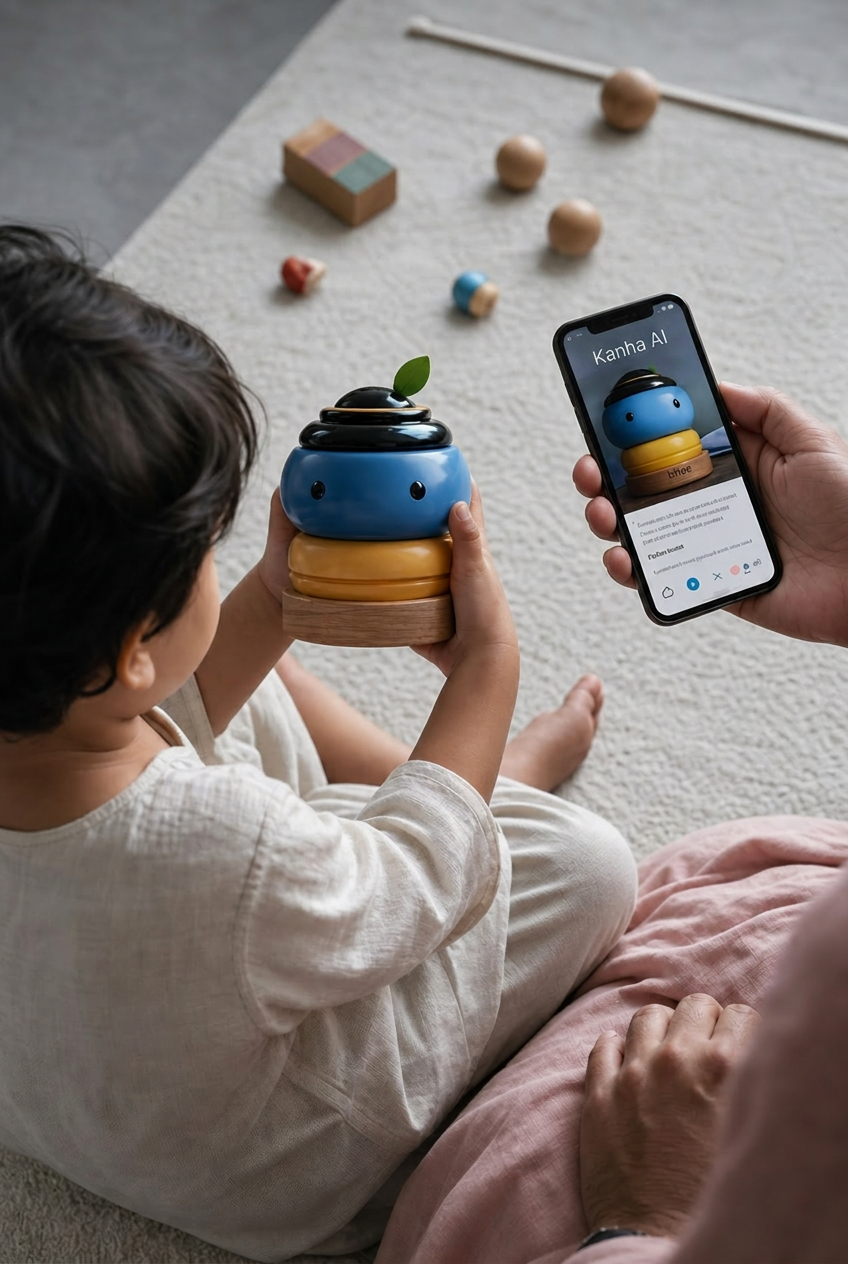
Governance sits at the centre, not the edge. A dashboard defines conversational boundaries, focus areas, time limits, quiet hours, and age modes - inside a closed ecosystem with no ads, no external influence, no unsafe content.
Intent: freedom for children within parent-defined safety.
The Quiet Signal
It notices. It does not decide.

Kanha detects concerning phrases or emotional cues and gently notifies parents when attention may be needed, encouraging human conversation rather than replacing it. It never diagnoses or labels the child.
Intent: strengthening care through timely parental presence.
Bringing It to Market
Existing products prioritise either technology or tradition. Rarely both.
AI toys are tech-first and screen-dependent - high engagement, low warmth. Handcrafted toys are trusted and warm but static. Kanha sits between three markets: not a gadget, not a religious object, not a learning tool. ₹7,999/year, device included above premium wooden toys, within reach of kids' smart speakers, premium but giftable, and justified by craft plus hardware plus AI plus app. Built for urban Indian parents aged 28–45, where purchase decisions turn on trust and developmental value, not entertainment.
A product this careful needed a voice to match. The identity splits the name across three tones, blue for K, black for anha, warm yellow for Ai because the project positions AI as friendly, warm, and child-safe.
Poppins, generous white space, soft neutral grounds: a system built to feel calm rather than clever.
The website follows the emotional logic of the decision itself -
Emotion → Differentiation → Meaning → Trust → Price → Objection Handling → Conversion because a parent doesn't buy this product until they've been reassured, in that order.
Hi, I'm Kanha. I like listening. I like stories. And I'm here to grow with your child.


Designed for Reassurance
A trust interface, not a surveillance tool, visibility without intrusion.
Parents named their fears plainly: overexposure to AI, screen dependency, unsafe information, data privacy, cultural misalignment. The app answers each.
-
Home - Activity summary, interaction time, mood indicators, upcoming routines, alerts. A single glance that answers is everything alright?
-
Interactions - Conversational themes: learning, creativity, mindfulness, play, social skills. Parents shape what Kanha talks about.
-
Routine - Wake-up reminders, homework time, playtime balance, bedtime stories, quiet hours.
-
Safety - Mic activation windows, privacy settings, content restrictions, age modes. The governance layer, made legible.
-
Insights - Mood pattern flags, escalation alerts, signs of withdrawal. Early awareness, never a diagnosis.


Kanha asked me to hold three things at once: a heritage craft with hard physical constraints, an AI system with real ethical stakes, and a business case that had to survive contact with a market.
The most useful discovery was that the constraints weren't obstacles, they were the design. Lac turnery's demand for rotational symmetry produced the rounded, limbless form that makes the object feel safe. The ethical decision to make AI a quiet presence produced the silence in its voice. The cultural need for familiarity produced the archetype. Every restriction pushed the product somewhere better than an unconstrained brief would have.
I also learned how much of designing for children is actually designing for parents, the person who buys, worries, and grants permission. Half this project is the object; the other half is the trust architecture around it.
To the artisans of Channapatna, whose craft this project rests on.
Reflection
Half this project is the object.
The other half is the trust around it.


The Space In Between
Four questions framed the project and the research answered them.
In Indian thought, childhood is not a phase to be accelerated, but a space to be protected.
In homes where both parents work, toys and screens become silent companions, technology fills the gap but overstimulates rather than comforts, while the traditional toys parents trust can't keep up in a world built on responsiveness.
Parents are left choosing between toys that feel safe and technologies that feel intelligent, because current products treat cognition and emotional warmth as separate problems when in a child's development they are the same one. No product today offers intelligence that is calm, culturally familiar, and screen-free while leaving parents in control.
Listening closely gave four answers: children seek presence, not stimulation, and toys that allow pauses hold attachment longer than toys that demand attention; parents value trust over novelty, built through calm behaviour and transparency rather than features; traditional toys feel safe but fail to grow with a child's curiosity; and cultural familiarity lowers resistance to new technology.

Technology
Tradition
Bridge tradition and intelligence, without the result feeling like a gadget. Support children in quiet moments, without replacing human relationships. Preserve innocence in an age of AI, calm, screen-free, non-overstimulating. Build trust with parents, an AI object they feel confident bringing home.

Which led to a harder question: what is AI allowed to be, in a child's life?
Children are still forming emotionally and cognitively, which makes them more susceptible to influence and overstimulation. Most AI toys optimise for engagement which quietly builds dependency. The concern is not AI itself, but AI without limits.
Kanha inverts that goal: AI not as the primary attraction, but as a gentle presence. Calm rather than addictive. Supportive rather than authoritative. This ethical position wasn't a constraint on the design, it was the brief. That shaped who it serves. Children, 3–7, curious and emotionally expressive, often alone in households where parents aren't always present. And parents, caring and cautious, worried about screen addiction and the loss of meaningful play. Rather than designing for a single stage, Kanha adapts as the child grows: gentle sound and presence in the earliest years, storytelling and playful tone from 3, and study prompts and routine support by 6 or 7.

Finding the Archetype
Before form or behaviour, I had to decide what kind of presence this should be.
Three archetypes were tested.
The Guide - reassuring, but instructional.
The Hero - motivating, but pressure-driven.
The Friend -warm, approachable, emotionally bonding.
The Friend won.
That pointed to cultural idols and the reasoning matters: the intention is not religion, but familiarity and archetype. Krishna, Ganesha, and Hanuman are figures children meet in stories and festivals long before theology. Generic robots feel impersonal and culturally untethered.
Krishna carries playfulness, curiosity, music, and companionship and is understood not only as divine but as a child who played and questioned. Philosophically, leela: life experienced as play. Abstracted into a non-devotional form, the toy becomes a friend, not a figure to obey.


Craft-Led, Not Tech-Led
Technology should disappear into the object.
Lathe-turned from Hale Mera ivory wood, finished in child-safe lacquer through traditional Channapatna lac turnery. A restrained bi-colour palette, muted blue over warm yellow, treats colour as an extension of material, not decoration.
Lac turnery imposed hard limits: forms must be rotationally symmetrical, built from cylinders and spheres, with no protruding limbs and no sculpted detail.
The design leaned in. Form exploration tested stacked proportions and the crown-and-leaf motif, pushing abstraction as far as it could go before recognition was lost. The rounded, limbless result is what makes the object feel safe in small hands and open enough that children bring their own meaning to it. The constraints weren't obstacles.
They were the design.
160 mm tall · base Ø122 mm · lathe turning · lacquer finish · Ivory wood
#235784 blue · #E4A34C yellow · #000000 black
And so the conversation begins.